
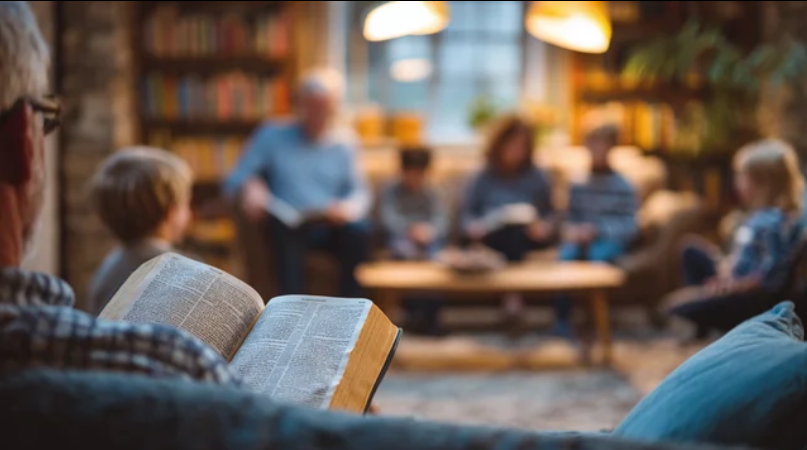
Legacy can be both a privilege and a burden. Merriam-Webster defines it as “something transmitted by or received from an ancestor or predecessor or from the past.” Legacy connects us to what those before us have given us. Thinking about our own legacy asks us to imagine what we will leave after we are no longer living on this planet.
As a child, I never questioned whether I would go to college—it was assumed. Many branches of our family tree include people who pursued higher education. Before immigrating to the United States, my paternal great-grandfather studied theology and business in Germany in the 1880s. My maternal great-aunt graduated from college in the 1920s and became a teacher. Their legacies, multiplied by those who came after them, carried a clear message: keep learning, pursue God’s will and remain curious. I recognize the privilege in those expectations and how much I have benefited from them.
Another ancestral legacy is the call to serve people. Our family tree is full of teachers and preachers—so many that my mother jokes my going into ministry shows this is a family “illness.” Here, perhaps, is where legacy can begin to feel like a burden. It was not assumed that I would pursue ordained ministry. And I tried not to place that assumption on our children.
I am the fourth generation of clergy in the same denomination, through our predecessor bodies, and I feel the responsibility to live up to those who came before me while at the same time claiming this tradition as my own. While researching United Church Homes at the time of our centennial, I discovered that my father’s uncle had chaired its board. That historical connection connected me more firmly in this vocational call and I take pride that he served during a very challenging period of time for the organization.
My sisters, Dave and I still direct a family camp that my father first directed 55 years ago. The camp is now a “thin” place for us, as it was for Dad, but in some years continuing that leadership has felt cumbersome—almost as if we had no choice.
Like all legacies, these gifts require discernment. We must decide what we will receive, which inheritances will shape us and how we will carry them forward.
Leaving a world for the people you love the most
We stand on legacies from those who have gone before, even as we build a legacy for those who will follow. This begins with recognizing that we will not live forever. After we die, the meaning of our lives will continue to echo in lives that carry on beyond our own.
I appreciate Bill McKibben’s definition of legacy in this video clip from the Stanford Center on Longevity:
“People have a real hunger to make a difference in the world….I think that that hunger is maybe strongest of all particularly at the end of your life. Until that time, legacy has been an abstract thing. Legacy is the world you leave behind for the people you love the most.”
An important part of McKibben’s legacy is his environmental work, bringing older adults together with others—especially younger generations—to change systems and structures that damage creation.
We do not all have to do the same thing. Each life rests on legacies connected to lived experience, ancestral history, culture and belief, and the communities around us.
Still, each of us can ask what matters most at this time in our lives. What aspirations does the divine use to fuel our imagination about the world we hope to shape now and leave for future generations? What skills and passions give us energy to work toward that vision?
Legacy is an act of faith and trust
Facing mortality also requires us to release control of the outcome. No matter how many instructions we leave—or whether we pass them through lawyers, clergy or family—we cannot control how future generations receive our work or its impact.
Consider Moses, who led the formerly enslaved people out of Egypt and through 40 years in the wilderness. At the heart of his leadership guiding the people was connecting them as a community with God. He brought them the tablets with the Commandments, taught them songs to remember what God had done and defended them before God. His work rested on God’s promise to Abraham and Sarah that the people would have a place where they belonged.
Moses’ story ends in Deuteronomy 34 on the shore of the Jordan River, with the promised land in sight. He never set foot there. He died after a long life, and the people mourned before following Joshua, the new leader, across the river.
We give our time and resources to people and causes because we can envision a better world. The challenge of legacy is accepting that we can only do what is ours to do—and that we may never see the realized vision that guided our hope and action.
Ultimately, is legacy about setting down a plan and ensuring everything is in place for future generations? Or is it about living in ways—through our choices and relationships—that reflect what we believe? When those who knew us remember our daily decisions, perhaps our legacy becomes a foundation for their own choices as they live faithful lives with the gifts and imagination they hold.
It is a privilege to consider what we hope our legacy will be, and to learn from those who came before us. My hope is that what I leave will not burden those who follow. I strive to do the best I can today and know that the world framing their lives may be very different from mine. Their choices will look different, too. May any legacy I leave offer not a script they must follow, but a foundation from which their decisions and lives can benefit.