
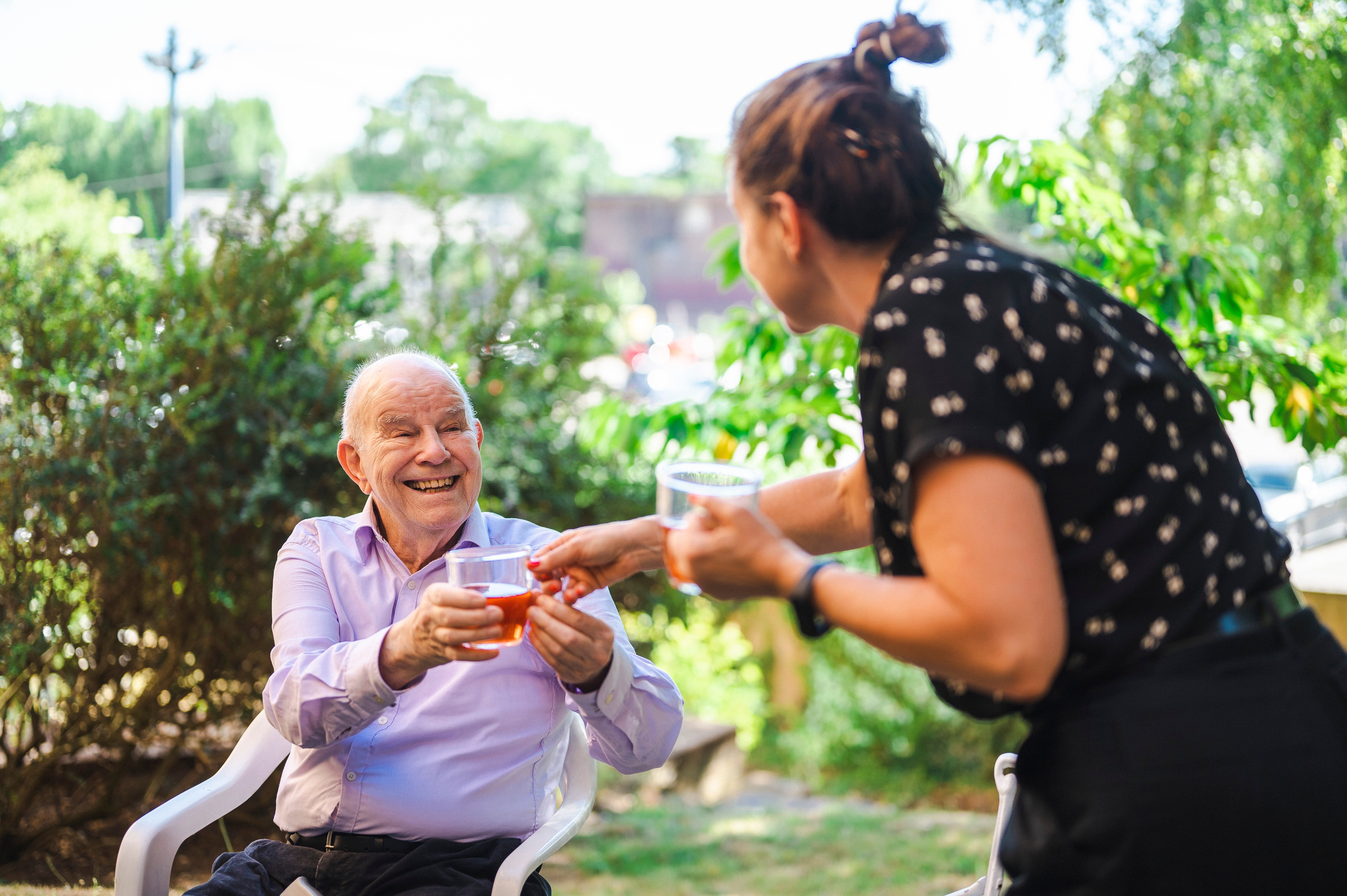
We have all heard the phrase, “It is better to give than to receive.”
Within its own context, there is wisdom there. Generosity can loosen our grip on what we have, turn our attention toward another person’s need, and remind us that abundance is meant to be shared.
But there is another side of generosity that receives far less attention.
Sometimes, the more difficult spiritual practice is not giving.
Sometimes, it is learning to receive with grace.
I learned something about that when I was in culinary school.
I was working hard on my education and, let’s be honest, I was a poor college kid working his way toward becoming a big, famous chef. Most Sundays, I would drive more than fifty miles to attend church with a family I had known for years.
I considered their children siblings. I considered Bob and Constance another set of parents. They loved me dearly, and I loved them.
Constance was the queen of the house, the very picture of grace and love. Bob was the pastor of the church. Together, I thought of them as my spiritual parents.
Bob—“the Alabama Slamma”—was a big, burly chiropractor and a charismatic preacher, truly a man whose voice could move mountains. Not only did they love me well, they cared for me when I came to visit. After worship, they would always take me along wherever they went for lunch.
Then came the familiar rhythm of the afternoon: worship, lunch, conversation, laughter, and a few hours of respite in their company before I began the hour-long drive back to college.
One Sunday, just before I got into my car, Bob swiftly handed me a folded $100 bill and said simply:
“For gas.”
I tried several times to give it back.
“No, it’s fine.”
“You don’t have to do that.”
“You’ve already done so much.”
Bob laughed his big, burly belly laugh. Then his eyes became serious—loving, but serious.
“I know you need it,” he said. “So just say thank you, and accept it with a smile.”
Then he pulled me into one of his engulfing bear hugs.
I said thank you with a big smile.
And that was that.
That moment has stayed with me because Bob understood something I was still learning: sometimes receiving is an act of trust. Sometimes the most gracious thing we can do is stop resisting love when it is offered.
Many of us are far more comfortable being the helper than being helped. We know how to bring the meal, write the check, offer the ride, watch the children, make the phone call, or show up when someone is struggling. Giving allows us to feel useful, capable, and generous.
Receiving can feel different.
Receiving asks us to admit that we have a need. It may require us to surrender some control, allow another person to see our vulnerability, or accept that we cannot do everything on our own.
Perhaps that is one reason the story of the Good Samaritan continues to challenge us.
We usually tell the story by focusing on the extraordinary generosity of the Samaritan. A man is attacked, robbed, beaten, and left beside the road. Others pass him by, but the Samaritan stops. He tends the man’s wounds, lifts him onto his own animal, carries him to safety, and pays for his care.
The Samaritan becomes the example of what it means to love one’s neighbor.
And rightly so.
But there is another part of the story worth noticing: the wounded man receives the Samaritan’s help.
Jesus does not identify the injured traveler’s ethnicity, though his original hearers may have imagined someone from their own community. What matters is that the person who comes near is a Samaritan—someone whom many in Jesus’ audience had been taught to regard with suspicion, contempt, or hostility.
The wounded man is placed in the care of someone he might never have chosen.
Had they met under ordinary circumstances, social and religious division might have kept them apart. Yet on the roadside, the wounded traveler’s healing depends upon receiving compassion from the very person he may have been conditioned to distrust.
The story asks us not only, “Will you become a neighbor to someone in need?”
It may also ask, “Will you allow an unexpected person to become a neighbor to you?”
Of course, the wounded man may have been too injured to object. The text says he was left half-dead. But that vulnerability makes the story even more powerful. He could not preserve his independence. He could not control who helped him, dictate the terms of his care, or repay the kindness immediately.
He simply had to be carried.
That may be one of the hardest experiences for any of us.
When someone offers to help, our instinct is often to say:
“Oh, I don’t need that.”
“You really don’t have to.”
“Thank you, but no thank you.”
“I can manage.”
Sometimes declining is appropriate. Healthy boundaries matter, and not every offer must be accepted. But sometimes our refusal is not about discernment. It is about discomfort.
We do not want to feel indebted. We do not want to appear incapable. We do not want to inconvenience anyone. We may have spent a lifetime believing that our value lies in what we can accomplish, provide, or carry for others.
Yet when we automatically refuse sincere generosity, we may unintentionally close the door on someone else’s opportunity to love.
Perhaps the Spirit has stirred that person to act. Perhaps they have been given the time, resources, compassion, or ability to meet a need. Perhaps offering help is part of their own growth, healing, or calling.
Receiving graciously does not mean believing that we are entitled to another person’s generosity. It means recognizing a gift for what it is and allowing ourselves to say, sincerely and simply:
“Thank you. I receive this with gratitude.”
What gracious receiving looks like may change throughout our lives.
In one season, it may mean accepting an unexpected financial gift without immediately insisting that it be repaid.
In another, it may mean allowing someone to watch our children simply because they want to give us an evening of rest.
It may mean letting a church, neighborhood, or social community surround us during illness, grief, unemployment, divorce, or another difficult transition.
It may mean accepting the gift of respite, Sabbath, or sabbatical when our bodies and spirits have carried too much for too long.
And as we grow older, it may mean allowing someone to help with a daily task that has become more difficult—even before we are fully ready to admit that it has become difficult.
A ride to an appointment.
Help carrying groceries.
A hand with yardwork.
Someone accompanying us through complicated paperwork.
A meal delivered to the door.
A steady arm offered on uncertain ground.
These moments can challenge our sense of independence. But receiving help does not make us less valuable, less capable, or less fully ourselves.
It makes us human.
Community is not built only when strong people help those in need. True community is built when all of us are free to move between giving and receiving—sometimes offering strength, sometimes admitting need, and always recognizing that no one is meant to travel alone.
A gracious receiver gives something, too.
They give another person the opportunity to serve.
They give trust.
They give honest access to their life.
They give the community permission to become what it claims to be: a place where burdens are shared, gifts are exchanged, and love moves in more than one direction.
Perhaps generosity is not a straight line from the person who has to the person who needs. Perhaps it is a circle in which each of us, over a lifetime, takes our turn giving, receiving, carrying, and being carried.
As we journey through life, new opportunities to receive will continue to find us. The invitation is not to surrender our agency or accept every offer placed before us. It is to remain open—to recognize when grace has arrived through another person and to welcome it without shame.
Maybe being a gracious receiver is not the opposite of generosity.
Maybe it is one of generosity’s most sacred forms.
And perhaps learning to receive with openness, gratitude, and trust is part of what it means to age abundantly.
Questions for Reflection
When has receiving help been more difficult for you than giving it?
What feelings arise when someone offers you care, time, money, or practical assistance?
Have you ever declined a gift because receiving it made you feel vulnerable?
Who has been an unexpected “neighbor” to you?
What might you need to receive graciously in this season of your life?