
At 43, I’ve found myself in a strange little age bracket.
I’m not the young one anymore. I’m also not exactly an older adult. I’m somewhere in that weird middle where I can remember phones with cords, but I also know what a TikTok is. My son just turned 18, and every now and then someone will say, “You’re not old enough to have a kid that age.”
I’m never quite sure what they mean by that. I was 25 when I had him.
Maybe they’re trying to be nice. Maybe I just look younger than they expected. Either way, it’s a strange thing to hear because, for most of my life, I have actually wanted to be older.
My mom used to call me an “old soul.”
She wasn’t wrong.
I Was Never Very Good at Staying in My Age Group
When I was around 10 years old, I would sit in church with the older adults.
Not my parents. Not my friends. The older adults.
I had my pick of whoever I thought was funny or interesting and apparently I decided those people were my people.
They were old enough to be my parents, grandparents or, in some cases, probably my great-grandparents. I knew they were older than me, but I didn’t think of them as old people. They were my friends.
And I treated them like friends. They treated me like a friend, too.
Looking back, I imagine it was probably pretty funny to them—a 10-year-old kid who had apparently decided she had outgrown the children's pew.
But those relationships mattered to me. I kept many of them for years. Some of those same people were at my wedding.
I think that's one of the first places I learned something important about intergenerational relationships: age doesn't have to determine who you connect with.
We often organize our lives into age groups. Kids hang out with kids. Teenagers hang out with teenagers. Young adults with young adults. Older adults with older adults.
There's nothing wrong with having peers who are your age. But something is lost when we assume that the only people who can understand us, teach us, laugh with us or contribute something meaningful to our lives are people who were born within a few years of us.
I learned that lesson long before I knew there was a name for it.
My Favorite Reality TV Was My Grandma's Kitchen
My grandmother was our babysitter until we were old enough to stay home alone.
I loved her house.
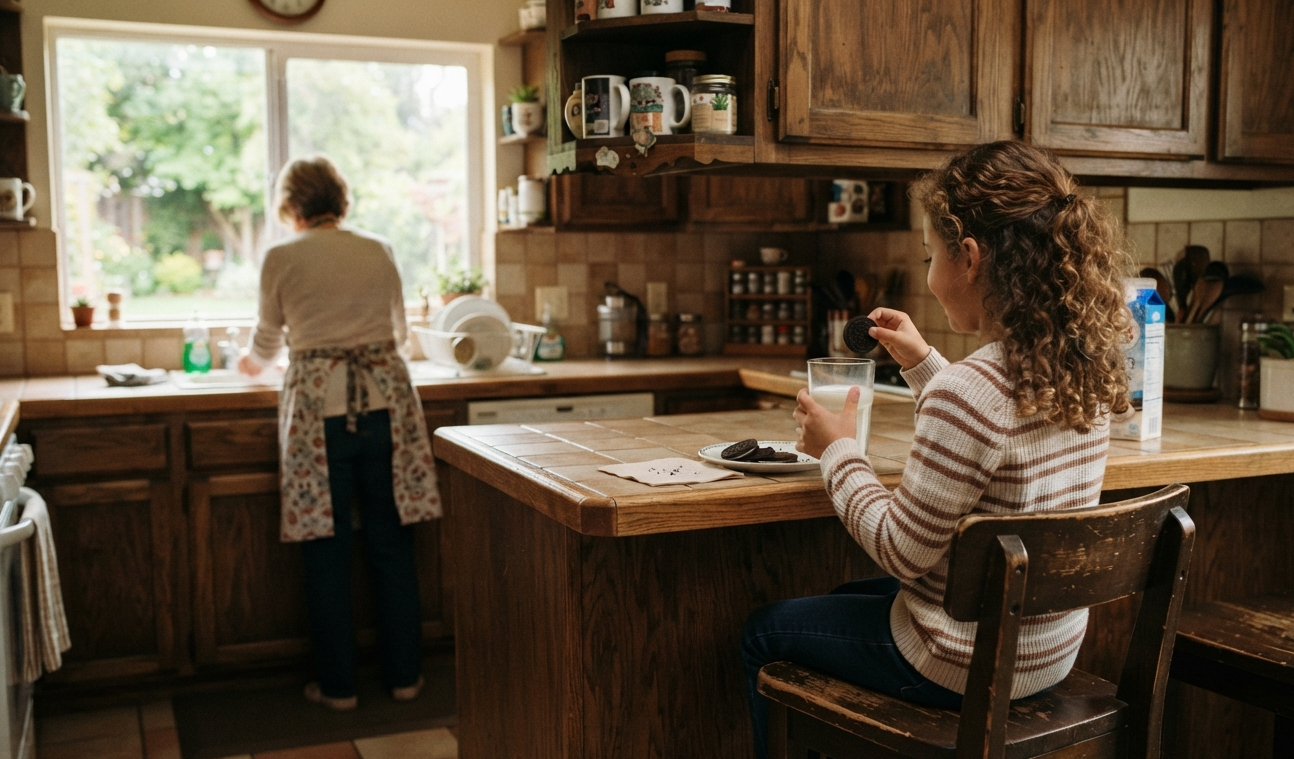
I would sit at her kitchen table and watch her make my lunch, do the dishes and put things away. She would talk to me, and I would talk to her.
Usually, there was a glass of milk and some Oreos involved because that was our version of fine dining.
But what I really loved were her stories.
She told me about life. She told me what my aunts were doing. She told me about the crazy things my grandpa was doing that irritated her.
It was basically reality television, the TV was my grandma and her kitchen was the production studio.
I loved every minute of it.
I didn't realize it then, but those ordinary conversations were giving me something I couldn't get from people my own age: perspective.
My grandmother had lived through things I had never experienced. She had memories I didn't have. She had watched people grow up, make mistakes, fall in love, raise families, lose people and start over.
She carried history in her stories. And I was lucky enough to sit at the kitchen table and listen.
Even My Parents' Friends Became My Friends
When my mom and dad had friends over for cards or whatever adults did for fun, their friends would bring their kids.
All the kids would go downstairs to play.
Except me.
I was upstairs playing cards with the adults.
I talked to them like I was one of them, and my mom thought the whole thing was hilarious.
At the time, I didn't understand why. Now I do.
I think I simply liked people who had stories. I liked people who had lived enough life to have something to say. And, I appreciated their humor more than whatever the kids downstairs were doing.
I Even Wanted an Older Husband
This tendency followed me into adulthood.
When I started looking for a husband, I wasn't interested in guys my own age.
I thought they were immature.
They weren't serious about life. They weren't serious about their faith. At least, that's how it seemed to me.
So I found someone older who suited me just right.
I'm not saying I had everything figured out. I absolutely did not. I'm not saying I've arrived at some magical destination called Maturity, either.
I'm just saying that, even as a young woman, I seemed to gravitate toward people who had more life experience than I did.
It has always felt natural to me.
Then I Grew Up and Made a Career Out of It
For years, I was actually afraid to tell people my age.
I worried they would think I was too young for my job.
Maybe they wouldn't take me seriously as a leader. Maybe they would assume I didn't have enough experience.
I'm not ashamed of getting older. I'm not ashamed of looking older. I'm not ashamed of feeling older.
It's just life.
And, honestly, aging has always felt a little bit like where I belong.
I realize that's not everyone's experience.
Some people spend their entire lives trying to feel younger. Some people dread getting older. Some people feel disconnected from older adults because they don't know how to relate to them.
I don't think I'm special because I have always been drawn to older people. If anything, I think I've just been unusually fortunate.
Somewhere along the way, I believe the Lord gave me a particular interest in older adults—and I've spent nearly my entire career working in senior living.
That has given me the opportunity to build relationships across generations in ways I never could have imagined when I was sitting in the church pew at 10 years old.
What Older Adults Have Taught Me
I've learned history from older adults. I've learned resilience.
I've learned that life rarely goes exactly according to plan.
I've learned that people can survive things they were certain would break them.
I've learned that families are complicated, marriages take work, grief changes you and sometimes the funniest stories come from the hardest seasons of life.
I've learned about careers, parenting, faith, love, disappointment and second chances.
I've also learned that wisdom doesn't always announce itself. Sometimes wisdom sounds like a story you've heard 14 times.
Sometimes it looks like sitting at a kitchen table with a glass of milk and a package of Oreos.
And sometimes it is simply the perspective that comes from having lived long enough to know that today's crisis probably isn't the end of the world.
That's a pretty valuable perspective when you're 15. Or 25. Or 43.
The Bible Has Something to Say About This, Too
Scripture doesn't present wisdom as something we are supposed to keep to ourselves.
Psalm 71:18 says: “Even when I am old and gray, do not forsake me, my God, till I declare your power to the next generation.”
I love that.
Older adults aren't simply people who have reached the end of their story. They have something to declare to the next generation. And the next generation needs to hear it.
Titus 2 gives us another picture of this kind of relationship, encouraging older men and women to teach and encourage those who are younger.
Generations need one another. Not one generation instead of another. One generation with another.
Intergenerational connections allow wisdom to move forward.
Aging Isn't About Becoming Less Relevant
I've spent most of my life thinking older people were interesting. They weren't interesting because they were old. They were interesting because they had lived.
And eventually, all of us will become the older generation.
The question isn't whether we're going to age. The question is what we will carry with us when we do.
Will we carry stories? Wisdom? Will we have relationships with people who are younger than us?
Will we make room for the next generation to sit at our table?
And will we be willing to sit at theirs?